
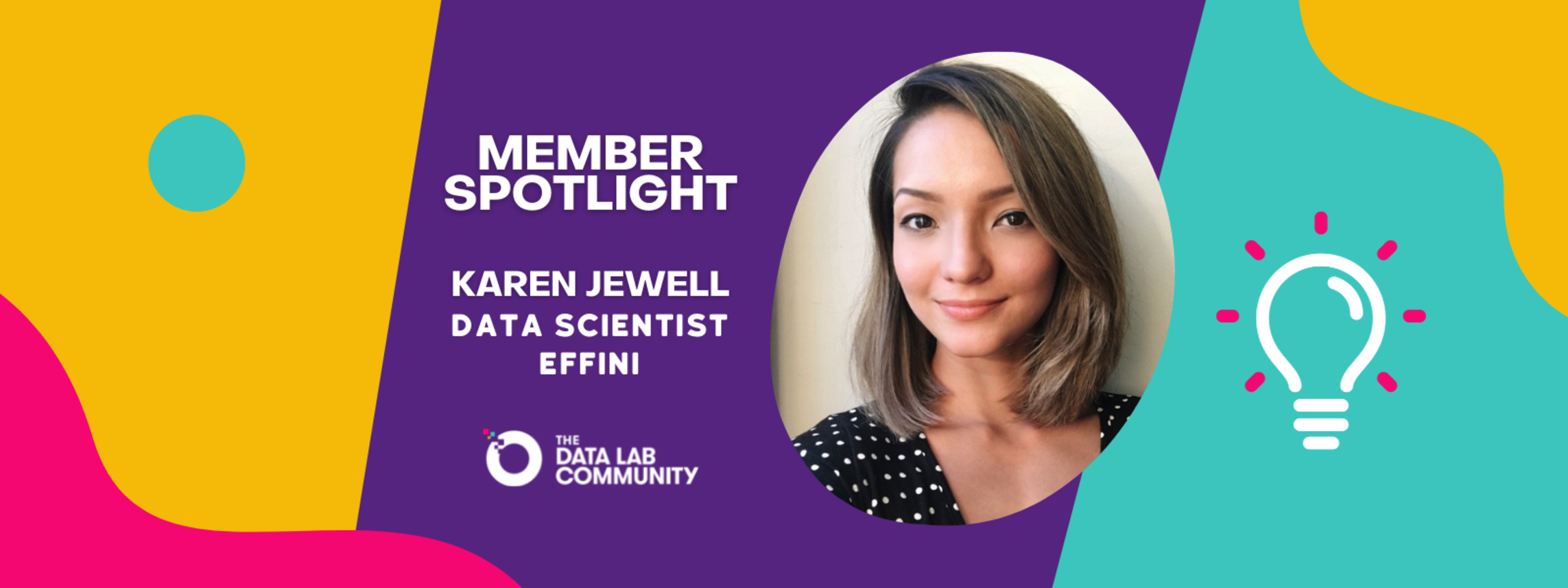
Member Spotlight: Karen Jewell, Data Scientist, Effini
This week, we caught up with Karen Jewell, Data Scientist at Effini, an expert data science company that enables any business to understand and utilise its data more effectively.
Hey Karen, great to have you with us! Can you tell us a wee bit about your background?
I am a Data Scientist at Effini but my background is in Business Management and Analytics. Before Effini, my career started with 3 years running corporate functions in the Leisure and Retail sector, then 7 years in the Energy sector as a Business Analyst and Data Analyst. The common theme in all those jobs was that I designed, built and tested tools for other people in management to make decisions.
I did my Bachelors in Business Management and my Masters in Data Science both at Robert Gordon University and I am now studying, again, doing a Bachelors in Mathematics and Statistics at the Open University.
Outside of my day job, I am a trustee for a charity called CodeTheCity which helps promote a tech and data community in Aberdeen and also promotes the uptake of open data practices on a more national scale. I am also a volunteer contributor on an open source project called Open Data Scotland which is trying to collate all the open data sources in Scotland so it is searchable from one point of reference, and bringing some insight into the Scottish Open Data landscape at the same time.
When I am not at a computer, I run (for fun!) and train for half-marathon races, I am also learning Scottish Gaelic on Duolingo and very proud of my current 580+ day streak.
How did your interest in Open Data come about?
I don’t think I became interested in it per say, but that I suddenly realised it impacted me. Then the more I paid attention and understood what was involved, the more I realised there was so much opportunity to add value and make the offering better, and more importantly that I had the skills to help that.
I think my journey to contribution has 3 key events: the first time I needed to source a dataset to use in my assignment for university, or it could have even been for school, would have been the first day I used Open Data.
The second key event was when I had an epiphany at the first Scottish Open Data Unconference (SODU) which was originally a DataFest 2020 Fringe event. I introduced myself as “somebody who doesn’t use Open Data but interested to find out what it is”, but as the day carried on, I realised that I’ve actually been using Open Data all along, just that I didn’t know its name. That made me realise that maybe, we ALL use Open Data, but we probably don’t know that’s what it is called, and so we don’t recognise ourselves as users of Open Data. But if you source data that is free-to-use without any conditions attached, that is Open Data.
The third key event was when I started actively promoting Open Data by contributing to the Open Data Scotland project. It started as a quick prototype of an idea at a CodeTheCity weekend hack event with a team of really talented developers, and when the weekend ended, so did the prototype. But when SODU 2021 came around, a couple of us did an impromptu (albeit sloppy) demo of that prototype to a small group of willing ears, and the feedback was so positive and encouraging, that it felt like such an awful shame to let the prototype die a quiet death.
So, post-event we banded together and decided to make something of it. We made a 12-month plan of action, invited interested contributors to a slack channel, set up project documentation in Github, employed the use of some clever open-source tools to speed up deployment, and now we are 7 months into the project and have a beautiful product to show for it. It is still a work in progress, but lovingly tended to whenever a contributor can offer a few spare hours.
As someone so involved in the Open Data community in Scotland, what is your assessment of the state of open data here right now?
I think Open Data in Scotland is alive and when we monitor change activity in dataset offering over time, we can see there is movement and that we have active publishers and consumers. But I’m not sure that we, as a community, collectively have clarity over what we have, and if we don’t know what we have, we don’t know what we don’t have either.
Part of what we’re doing at Open Data Scotland, is trying to make some sense of the environment in Scotland, by analysing the metadata and finding out where those gaps are. For example, the prototype started by aggregating the portals of the 32 Local Authorities in Scotland, that’s an objectively complete set and we could identify Open Data offerings for 14 of those Local Authorities. Yet that’s 18 without, that’s a gap there. The resulting impact is that individuals in those 18 Local Authorities do not have ready access to data relevant to them and their area, the onus is on an individual to make a request for the data and for the Local Authority to react on an ad-hoc basis, each time.
What do you think could be done to improve the situation?
I have a lot of sympathy for publishers who have to justify maintaining these resources yet having little to show for their efforts, making it hard to dedicate more resources to support the publication of even more datasets to address those gaps we’re talking about.
The funny catch about Open Data is because it comes without conditions, there is little to no feedback from user to publisher when a user successfully employs an open data source. I’m willing to raise my own hand and say I’m guilty of this too – I couldn’t tell you how many open datasets I’ve downloaded in the last 2 years alone and what I did with them.
So somehow, we need to close that feedback loop. We as beneficiaries of Open Data need to support our publishers in helping them continue their good work.
How do you think we should measure what successful open data use looks like?
This is the big question on my mind too! How can we identify something is successful if we don’t know what that success looks like? We have the FAIR principles which are a great set of indicators for the publication of Open Data, but what about successful USE of Open Data?
There are possibly 4 main dimensions I’ve heard so far around: Volume, Trust, Skills and Financial value. That is, if enough people use a source; if enough people trust or rely on a source over other similar sources; If somebody has used the data to develop their own professional or hobby skills; or if the value of benefit outweighs the financial cost of maintaining the resource.
I don’t think this is a complete listing, there are possibly more indicators of success and a hundred other ways we might make combinations of them. It’s a great topic open for exploring and I’d love to hear anyone’s take on it.
What are you working on at the moment that excites you the most?
My biggest challenge at the moment is actually in training for the Edinburgh Half Marathon in May. But my biggest data-related challenge is in figuring out how Open Data Scotland might categorise 1000+ open data datasets from different publishers without manually labelling each one, ideally making the solution flexible enough to accommodate future new and unseen publisher’s datasets.
What is your top tip for aspiring data professionals?
Create the opportunities to practice your skills – we get good at what we practice. In the same way we have to put hours of practice in learning how to play a musical instrument well, or all the exercise we have to do to become good at a sport, developing our skills in data isn’t really that different.
The Data Lab values are Support, Respect, Innovate & Grow - which one resonates with you most at the moment and why?
It’s definitely Grow. My side endeavours are all contributing to my growth as an individual, to my skills and my character. Open Data Scotland as a public resource is growing as we add more publishers and datasets to the listing, and it has SO much potential for more. Effini (my employer) is also growing! We have two open positions for a Software Engineer and a Senior Data Scientist at the moment.
What motivated you to join The Data Lab Community? Have you found it valuable so far?
I am an alumni of The Data Lab MSc program in 2019/20 and truly benefited from being engaged with the program, I see joining the Data Lab Community as an extension to that wonderful program and taking it into my career. Just being exposed to the experiences of other data professionals locally is a huge benefit, but I’m also looking forward to the mentor training session offered to The Data Lab Community coming soon. That will benefit my capabilities as an individual and prepare me to be in a position to extend support to other individuals who are now in the position I was in 2 years ago.
How could you help other members of the community?
Well, it might come as no surprise, but I know a few sources of local Open Data if you ever find yourself needing some free-to-use data. I also have a few ideas for Open Data Scotland which could make for interesting small projects to practice data skills on and can double up as public projects to add to your portfolio.
Is there any way that members of the community could help you?
I am on the lookout for projects which have used Open Data from Scotland – if you have created any, or know of any, please send a link my way. Open Data Scotland is also always happy to welcome contributors who can spare a few hours on the project, whether in development or in providing user feedback - let us know how we can make it a better resource for everyon
Massive thanks to Karen for taking the time for a chat amongst her job, studies and multiple projects! We really appreciate it!
If you'd like to be featured in one of our Member Spotlights just get in touch via [email protected] or drop our community manager Paul a DM.